

| Titel: |
Titel:
Traceable in-situ calibration of low activity concentration radon detectors
|
| Autoren: |
Autoren:
Röttger, Stefan, Physikalisch-Technische Bundesanstalt (PTB), Fachbereich 6.1, Radioaktivität, ORCID: 0000-0002-4750-9563Mertes, Florian, Bundesamt für Strahlenschutz (BfS), Salzgitter, GERMANY, ORCID: 0000-0003-0217-284 Chambers, Scott, Australian Nuclear Science and Technology Organisation (ANSTO), Lucas Heights, New South Wales, AUSTRALIA, ORCID: 0000-0002-2521-959X Griffiths, Alan, Australian Nuclear Science and Technology Organisation (ANSTO), Lucas Heights, New South Wales, AUSTRALIA, ORCID: 0000-0003-1135-1810 Roger, Curcoll, Universitat Politècnica de Catalunya - Institute of Energy Technologies (UPC-INTE), Barcelona, SPAIN, ORCID: 0000-0002-8025-673X Alle Autoren anzeigen (8) |
| Beitragende: |
Beitragende:
HostingInstitution: Physikalisch-Technische Bundesanstalt (PTB), ISNI: 0000 0001 2186 1887
|
| Seiten: |
Seiten:
13
|
| Sprachen: |
Sprachen:
Englisch
|
| DOI: |
DOI:
10.7795/810.20260303
|
| Art der Ressource: |
Art der Ressource:
PTB: Konferenzartikel,
DINI: ConferencePaper,
DataCite: ConferencePaper
|
| Verlag: |
Verlag:
Physikalisch-Technische Bundesanstalt (PTB)
|
| Erscheinungsjahr: |
Erscheinungsjahr:
2026
|
| Rechte: |
Rechte:
https://creativecommons.org/licenses/by/4.0/Creative Commons Attribution 4.0 International (CC BY 4.0) |
| Beziehungen: |
Beziehungen:
IsIdenticalTo: DOI
10.1016/j.apradiso.2026.112485
IsPartOf: ISSN 0969-8043 |
| Datumsangaben: |
Datumsangaben:
Verfügbar:
2026-03-03
Herausgegeben: 2026-05 |
| Datei: |
Datei:
Datei herunterladen
(application/pdf)
4.5 MB
MD5 Prüfsumme: 96041e7748ed2f0e72505a7ca8a623d1 SHA256 Prüfsumme: f3f6864345a99a6e0e482805f4e781186a7672ebfb4e35e5975ea3d365919d03 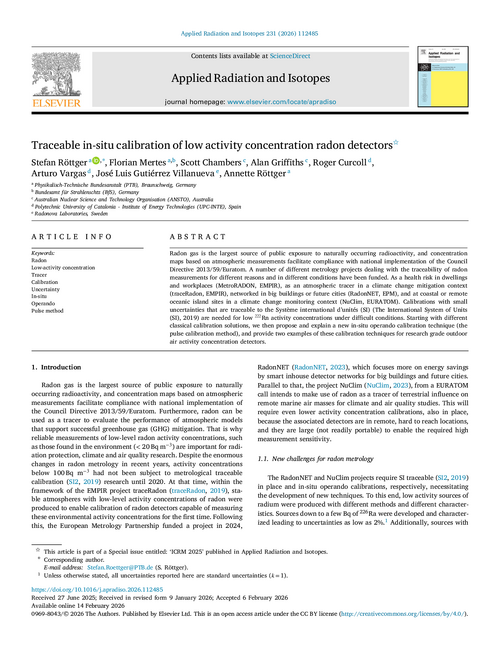
|
| Stichwörter: |
Stichwörter:
Radon ;
Low-activity calibration ;
Electronic monitors ;
Background build-up ;
GHG baseline
|
| Zusammenfassung: |
Zusammenfassung:
Radon gas is the largest source of public exposure to naturally occurring radioactivity, and concentration maps based on atmospheric measurements facilitate compliance with national implementation of the Council Directive 2013/59/Euratom. A number of different metrology projects dealing with the traceability of radon measurements for different reasons and in different conditions have been funded. As a health risk in dwellings and workplaces (MetroRADON, EMPIR), as an atmospheric tracer in a climate change mitigation context (traceRadon, EMPIR), networked in big buildings or future cities (RadonNET, EPM), and at coastal or remote oceanic island sites in a climate change monitoring context (NuClim, EURATOM). Calibrations with small uncertainties that are traceable to the Système international d’unités (SI) (The International System of Units (SI), 2019) are needed for low 222Rn activity concentrations under difficult conditions. Starting with different classical calibration solutions, we then propose and explain a new in-situ operando calibration technique (the pulse calibration method), and provide two examples of these calibration techniques for research grade outdoor air activity concentration detectors.
|
| Bemerkung: |
Bemerkung:
Originally published in Applied Radiation and Isotopes Volume 231, May 2026, 112485. DOI: 10.1016/j.apradiso.2026.112485
|
| Förderung: |
Förderung:
Förderer: European Commission (EC), ISNI: 0000 0001 2162 673XProjekt: 23IND07 RadonNET , Radon metrology: Sensor networks for large buildings and future cities Förderer: European Commission (EC), ISNI: 0000 0001 2162 673X Projekt: GAP 101166515 NuClim , Nuclear observations to improve Climate research and GHG emission estimates |
Zitieren
Röttger, S., Mertes, F., Chambers, S., Griffiths, A., Roger, C., Vargas, A., Gutiérrez Vilanueva, J.-L., & Röttger, A. (2026). Traceable in-situ calibration of low activity concentration radon detectors. Physikalisch-Technische Bundesanstalt (PTB). https://doi.org/10.7795/810.20260303
Exportieren